Showing posts with label drug abuse. Show all posts

Sunday, March 20, 2016

Support Groups for Neonatal Abstinence Syndrome

This blog post contains some support groups and community resources for individuals or families affected by Neonatal Abstinence Syndrome (NAS). Click the titles of each organization/group to access their website!
For anyone with an infant affected by NAS:
This organization located in Washington State provides short-term care for infants affected by NAS who require intermediate medical attention but are not ready to go home without medical supervision yet. Although these infants are no longer in need of intensive care in a NICU environment, they can still have dangerous symptoms that parents may not be equipped to handle. For parents, adjusting to caring for an infant is hard enough with out a NAS condition, so this program allows them to receive further support with this difficult change in their lives.

For parents of infants with NAS seeking treatment for substance abuse:
Methadone treatment centers
Women who abuse substances and have recently found out they are pregnant are not advised to "quit cold-turkey" because this is medically dangerous not only for the mother but also for the fetus. Withdrawal symptoms cannot be treated in unborn babies. An alternative for soon-to-be mothers seeking treatment is a methadone treatment program that weans the participant off of their opioid of choice with methadone which is a drug that is easier to eventually stop using. This site has links to methadone treatment centers by state. Don't wait, start now in finding treatment for yourself and your future child!
This website is a search engine for finding certified treatment centers for drug or alcohol abuse. Parents of children already diagnosed with NAS who want to change their lifestyle can search here for treatment programs. This step is extremely important in finding support going forward in your life and the life of your child. 


For adoptive parents of infants with NAS:
Adoptive parent support groups
New parents who have adopted a NAS-affected infant may find it challenging to accept their child's condition, or the situations that lead to it. Adoptive parent groups are incredible resources for adoptive parents to come together and share their experiences. Social events, encouragement, advice and support are often available in groups like these. Search with this website's engine to find a local adoptive parent group that fits your needs!

Friday, March 4, 2016

Internet Resources for Neonatal Abstinence Syndrome

This post lists several informational websites that may be helpful for pregnant or recently pregnant mothers who either have infants at risk for Neonatal Abstinence Syndrome (NAS), or have an infant diagnosed with NAS. 


1. Medscape - NAS background (click here)
This website provides detailed information about the signs/symptoms, causes, and pathophysiology (or disease process) of NAS. The website conveniently lays out a common process of assessment, diagnosis, confirmation, and treatment of NAS. Parents who are interested in how this process works will find this website very helpful to explain some of the procedures or assessments done for their infant by healthcare professionals. 

2. March of Dimes - Risks of NAS (click here)
This website provides an overview of what NAS is, why it is a problem for infants, ways to prevent NAS, signs and symptoms that might indicate NAS, and how it is commonly treated in the hospital. This website specifically highlights some of the dangerous conditions infants can develop from NAS such as low birth weight, breastfeeding problems, seizures, and birth defects. It also emphasizes that quitting "cold turkey" is incredibly dangerous for both the mother and the infant.


3. Substance Abuse and Mental Health Services Administration - Treatment for the mother (click here)
This website is a portal that allows mothers or expectant mothers who are addicted to drug substances to search and find authorized treatment centers and facilities. This is essential in ensuring a healthy life and lifestyle for both the infant and the mother. The mother's health and ability to take care of her infant have incredible influences not only on how well her infant will grow and develop, but may even have an impact on whether she can keep her baby at all! If you are concerned about whether or not your infant may be at risk for NAS or if your infant is already diagnosed, please seek life-restoring treatment through this website to benefit both yourself and your child.

4. The Children's Hospital of Philadelphia - Treatment for the infant (click here)
This website lays out information about  the treatment pathway that would be followed in an NICU setting where an infant diagnosed with NAS would be treated. This provides vital information for parents who might be wondering about the specifics of how their infant will be treated, and what kinds of improvements are essential for discharge. By clicking on the highlighted links within the website, visitors can find additional information. While treatment pathways may not be the same for every facility, this is a common regimen that has been supported by research. Eventually, it may become a universally accepted treatment pathway for infants with NAS. 


References
1. emedicine.medscape.com/article/978763-treatment
2. www.marchofdimes.org/complications/neonatal-abstinence-syndrome-(nas).aspx
3. findtreatment.samhsa.gov/
4. www.chop.edu/clinical-pathway/neonatal-abstinence-syndrome-clinical-pathway

Tuesday, March 1, 2016

Treatment of Neonatal Abstinence Syndrome

Treatment of opioid-induced Neonatal Abstinence Syndrome (NAS) has only recently been closely studied. Although it has become more standardized as more research is done on the subject, many hospitals still do not have standard protocols they follow to treat the newborns affected by NAS or they have only recently developed these guidelines. 

Research has discovered some treatment interventions that should be done, and some that shouldn't. For example, Naloxone, the medication used to reverse dangerous side effects of opiate overdose such as respiratory depression, is contraindicated for NAS-affected infants. It has been shown to exacerbated the symptoms of NAS and can bring on seizures in withdrawing infants (Kocherlakota, 2014). 

Non-Pharmacologic Treatment
Figure 1. Swaddling
These interventions do not involve drugs or medications and their goals include providing for adequate rest and nutrition, comfortably integrating the infant into their new social environment, and establishing a consistent pattern of growth. Some treatments include:
- Reducing environmental stimuli (dimming lights, turning down loud sounds)
- Avoiding self-stimulation (swaddling, careful/comfortable positioning, swaying, rocking)
- Responding to infant's physiologic needs (providing high-calorie formula or breast milk to stimulate growth)
(Hudak, Tan, The Committee on Drugs, & The Committee on Fetus and Newborn, 2012).

Pharmacological Treatment
The most effective pharmacological treatment regimen that has been researched is a weaning system involving either morphine or methadone. In the table below, these two front line medications are compared. 
Treatment
Dosage
Action
Notes
Cons
Morphine
0.05 mg/kg per day to 1.3 mg/kg per day
Decreases incidence of seizures, improves feeding, decreases irritability.
Most commonly used method of pharmacological treatment, solution is stable and easy to administer via oral route, the dosage is also easily titrated because of the short half-life of morphine
Increases length of hospital stay, must be administered every 3-4 hours because of the short half-life of morphine
Methadone
 0.1mg/kg/12HRS with dose reduction of 10-20% per week
Similar to that of morphine
Well absorbed via oral route of administration, has a long half life which decreases the number of needed administrations
Difficult to titrate because of the long half-life of methadone
(Hudak, Tan, The Committee on Drugs, & The Committee on Fetus and Newborn, 2012), (Kocherlakota, 2014)

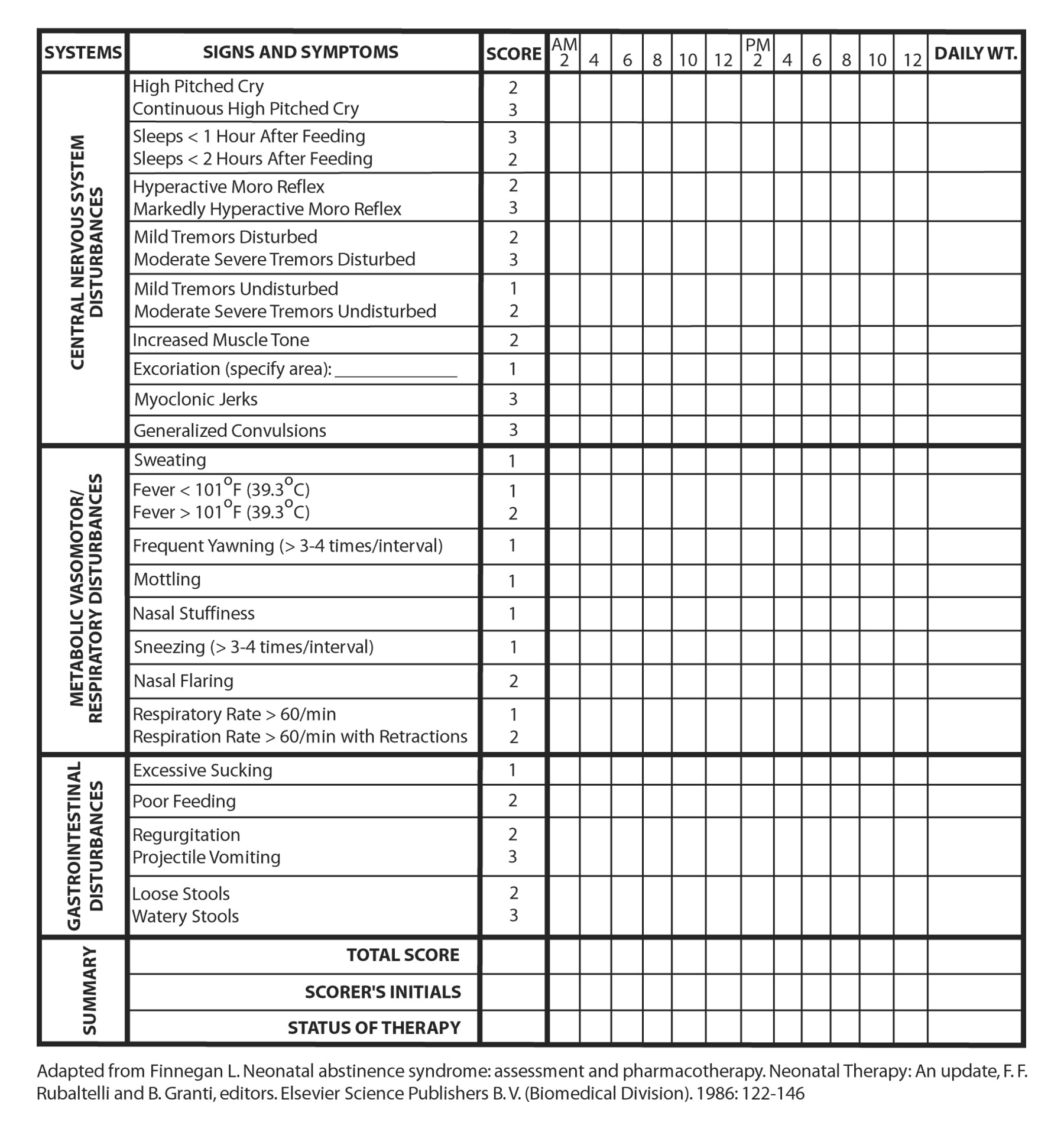
Treatment plans are heavily influenced by scores collected via the Neonatal Abstinence Syndrome Scoring System (click here). Based on a treatment plan like the one in Figure 2, using a standardized scoring system, a score of  8 three time in a row, or 1 score of ≥12 triggers medication administration. At each reassessment of the neonate, medication dosing may increase or decrease based on the withdrawal symptoms shown by the infant. 


Figure 2. NAS Treatment Plan (Kocherlakota, 2014)
Click to enlarge
The ultimate goal of both pharmacological and non-pharmacological treatments is to reduce suffering and improve the infant's growth and entrance into their new life. It is essential to understand that each case is highly variable based on the addicting drug, the length and severity of addiction, the symptoms shown by the infant, and more. Advances are frequently followed by set-backs, and successful weaning could take weeks to months. Despite these giant hurdles, hope for recovery is found in the caring arms of nurses and physicians who are dedicated to providing relief from this challenging start to life (Hudak et al, 2012)


References

Hudak, M., Tan, R., The Committee on Drugs, & The Committee on Fetus and Newborn. (2012) Neonatal drug withdrawal. Pediatrics, 129(2), 540-560. doi: 10.1542/peds.2011-3212.

Kocherlakota, P. (2014). Neonatal Abstinence Syndrome. Pediatrics, 134(2), 547-561. doi: 10.1542/peds.2013-3524

Monday, February 22, 2016

Symptoms of Neonatal Abstinence Syndrome

Signs and symptoms of Neonatal Abstinence Syndrome (NAS) usually begin anywhere within 24 hours to 7 days after birth depending on what substance was used by the mother.

The Neonatal Abstinence Syndrome Scoring System (click here) lists signs and symptoms that are monitored to score the severity of NAS. The percentage of infants that experience specific symptoms is poorly reported as research on this condition has only recently received focused attention. However, more severe symptoms have been more closely monitored and it is reported that 2-11% of infants with NAS experiencing seizures and over 30% experiencing ECG abnormalities.While individual infant responses to NAS may vary on the type(s) of drugs used by the mother, some of the most common include tremors, irritability (difficulty being comfortable), excessive crying, high pitched crying, sleep problems, vomiting, diarrhea and poor feeding (Hudak, Tan, The Committee on Drugs, & The Committee on Fetus and Newborn, 2012). Below are video examples of some of these common symptoms.

Tremors - these are sometimes mistaken as shivering, but notice the infants often pull their hands to their mouths while their legs show a kicking action.


Cry- While all babies cry, the NAS cry is very distinct because it is usually high-pitched and often occurs even when the babies are being consoled by swaddling, feeding, or holding. 


Overall, these symptoms show that infants experiencing NAS suffer greatly during their withdrawal. The majority of these symptoms can have dangerous effects on the infant. Decreased sleep, ineffective feeding, seizures, fever, abnormal respiratory rate, vomiting and diarrhea all can have severe negative outcomes for the infant as they begin the first few days of their new life. As was mentioned in earlier posts, most infants diagnosed with NAS end up staying in the NICU during recovery, and their length of stay is on average longer than infants who stay in the NICU for other reasons (Tolia, Patrick, Bennett, Murthy, Sousa, Smith, Clark, & Spitzer, 2015). Supervised recovery under the care of medial professionals is the only safe way to help an infant through these dangerous symptoms. Next week's blog will go into more detail on what NAS recovery looks like.

References

Hudak, M., Tan, R., The Committee on Drugs, & The Committee on Fetus and Newborn. (2012) Neonatal drug withdrawal. Pediatrics, 129(2), 540-560. doi: 10.1542/peds.2011-3212

Tolia, V., Patrick, S., Bennett, M., Murthy, K., Sousa, J., Smith, B., Clark, R., & Spitzer, A. (2015). Increasing incidence of the neonatal abstinence syndrome in U.S. neonatal ICUs. The New England Journal of Medicine, 372(22), 2118-2126.

Tuesday, February 9, 2016

Disease Process of Neonatal Abstinence Syndrome

The exact cause of Neonatal Abstinence Syndrome is the sudden discontinuation of infant exposure of to substances that were used by mothers during pregnancy. The most common substance that causes NAS is opioids such as heroin, codeine, oxycodone, methadone, or buprenorphine. Birth initiates the cessation from whatever substance is being used by the mother and allows the onset of a dangerous withdrawal period.

Figure 1. Transfer of opioids across the placenta 
(Neonatal Abstinence Syndrome, 2010).
The pathophysiology of NAS is not completely understood, but it definitely involves multiple body systems and could have still unknown effects on the long-term health and quality of life of the infant. The drug substance makes its entry into the bloodstream of the newborn via the placenta (Figure 1). Opiates are water soluble, low molecular weight substances that can easily cross this otherwise protective barrier between the bloodstream of the mother and fetus. As the fetus grows and demands more nutrients from mom, this transfer of opioids increases.


Figure 2. Mechanism of opioid withdrawal in neonates (Kocherlakota, 2014)
All opioids act primarily on opioid receptors in the central nervous system, peripheral nervous system, and the gastrointestinal system among others. As the substance abuse continues throughout birth, the fetus's body becomes accustomed to this receptor stimulation. When the stimulation of these opioid receptors is abruptly stopped by birth, a chain reaction is triggered in the newborn body. 

The absence of opioids triggers the production of norepinepherine, acetylcholine and corticotrophin. Additionally, the production of dopamine decreases during this withdrawal period. The ability of the autonomic and peripheral nervous systems and the gastrointestinal system to work properly is also affected after extended exposure to the opioids. See a complete diagram explaining the cascade to the left (Figure 2). Next week's blog will discuss how these different neurotransmitter and hormone changes cause dangerous responses in the newborn. 


References
Kocherlakota, P. (2014). Neonatal Abstinence Syndrome. Pediatrics, 134(2), 547-561. doi: 10.1542/peds.2013-3524

Neonatal Abstinence Syndrome. (2010). Retrieved from http://images.walgreens.com/marketing/library/contents.jsp?docid=19888&doctype=2

Wednesday, January 20, 2016

Prenatal Drug Exposure and Neonatal Abstinence Syndrome

Although every newborn faces incredible changes at the moment of birth, those that experience Neonatal Abstinence Syndrome (NAS) are faced with an extra challenge. NAS is defined as “a group of problems that occur in a newborn who was exposed to addictive opiate drugs while in the mother’s womb” (MedlinePlus, 2014). Prenatal exposure to opiates, narcotics, and other drugs can create unwitting newborn addicts whose bodies have become physiologically dependent on their mother’s drug(s) of choice. For these newborns at the moment of birth, even as their heart takes sole responsibility for circulating blood, and their lungs learn to suck in air instead of amniotic fluid, their entire body is wracked by dangerous withdrawals.

Image retrieved from www.medscape.com/viewarticle/840696
Unfortunately the sad reality is that these newborns are facing the harsh consequences of actions well beyond their control. While information about the risks of drug use during pregnancy is easily accessible and commonly shared by healthcare providers, many mothers still use or abuse dangerous drugs during pregnancy (Bersani, Corsello, Mastandrea, Patacchiola, Voligno, Garofalo, & Dotta). Besides the physiological implications of NAS, there are also social and legal implications of drug use during pregnancy. Any physician who identifies NAS or other symptoms of drug exposure in a newborn is required by the 2003 Keeping Children and Families Safe Act to report the findings to their state Child Protective Services. Procedures and guidelines for responding to these reports vary from state to state. But as of 2006, 13 states and the District of Columbia identify prenatal drug exposure as a form of child abuse or neglect which can have implications on the mother's ability to keep her baby after birth (U.S. Department of Health and Human Services, 2009).

The impact of prenatal drug exposure ranges from physiological, to social, and beyond. Healthcare providers must understand the challenges faced by both the mother and the baby when NAS or other symptoms of drug exposure occur in a newborn. Physicians, nurses, midwives, and others involved in the birthing process must know how to intervene effectively and respond compassionately when babies are born addicted.


References

Bersani, I., Corsello, M., Mastandrea, M., Patacchiola, V., Foligno, S., Garofalo, V., & Dotta, A. (2013). Neonatal abstinence syndrome. Early Human Development 89(4) S85-S87.
MedlinePlus. U.S. National Library of Medicine. (2014). Neonatal abstinence syndrome. Retrieved from www.nlm.nih.gov/medlineplus/ency/article/007313.htm
U.S. Department of Health and Human Services. (2009). Protecting children in families affected by substance use disorders. Child Abuse and Neglect User Manuel Series. Retrieved from www.childwelfare.gov/pubPDFs/substanceuse.pdf#page=51&view=CHAPTER 6 The Role of Child Protective Services When Substance Use Disorders AreIdentified