Showing posts with label history. Show all posts

Tuesday, March 1, 2016

Treatment of Neonatal Abstinence Syndrome

Treatment of opioid-induced Neonatal Abstinence Syndrome (NAS) has only recently been closely studied. Although it has become more standardized as more research is done on the subject, many hospitals still do not have standard protocols they follow to treat the newborns affected by NAS or they have only recently developed these guidelines. 

Research has discovered some treatment interventions that should be done, and some that shouldn't. For example, Naloxone, the medication used to reverse dangerous side effects of opiate overdose such as respiratory depression, is contraindicated for NAS-affected infants. It has been shown to exacerbated the symptoms of NAS and can bring on seizures in withdrawing infants (Kocherlakota, 2014). 

Non-Pharmacologic Treatment
Figure 1. Swaddling
These interventions do not involve drugs or medications and their goals include providing for adequate rest and nutrition, comfortably integrating the infant into their new social environment, and establishing a consistent pattern of growth. Some treatments include:
- Reducing environmental stimuli (dimming lights, turning down loud sounds)
- Avoiding self-stimulation (swaddling, careful/comfortable positioning, swaying, rocking)
- Responding to infant's physiologic needs (providing high-calorie formula or breast milk to stimulate growth)
(Hudak, Tan, The Committee on Drugs, & The Committee on Fetus and Newborn, 2012).

Pharmacological Treatment
The most effective pharmacological treatment regimen that has been researched is a weaning system involving either morphine or methadone. In the table below, these two front line medications are compared. 
Treatment
Dosage
Action
Notes
Cons
Morphine
0.05 mg/kg per day to 1.3 mg/kg per day
Decreases incidence of seizures, improves feeding, decreases irritability.
Most commonly used method of pharmacological treatment, solution is stable and easy to administer via oral route, the dosage is also easily titrated because of the short half-life of morphine
Increases length of hospital stay, must be administered every 3-4 hours because of the short half-life of morphine
Methadone
 0.1mg/kg/12HRS with dose reduction of 10-20% per week
Similar to that of morphine
Well absorbed via oral route of administration, has a long half life which decreases the number of needed administrations
Difficult to titrate because of the long half-life of methadone
(Hudak, Tan, The Committee on Drugs, & The Committee on Fetus and Newborn, 2012), (Kocherlakota, 2014)

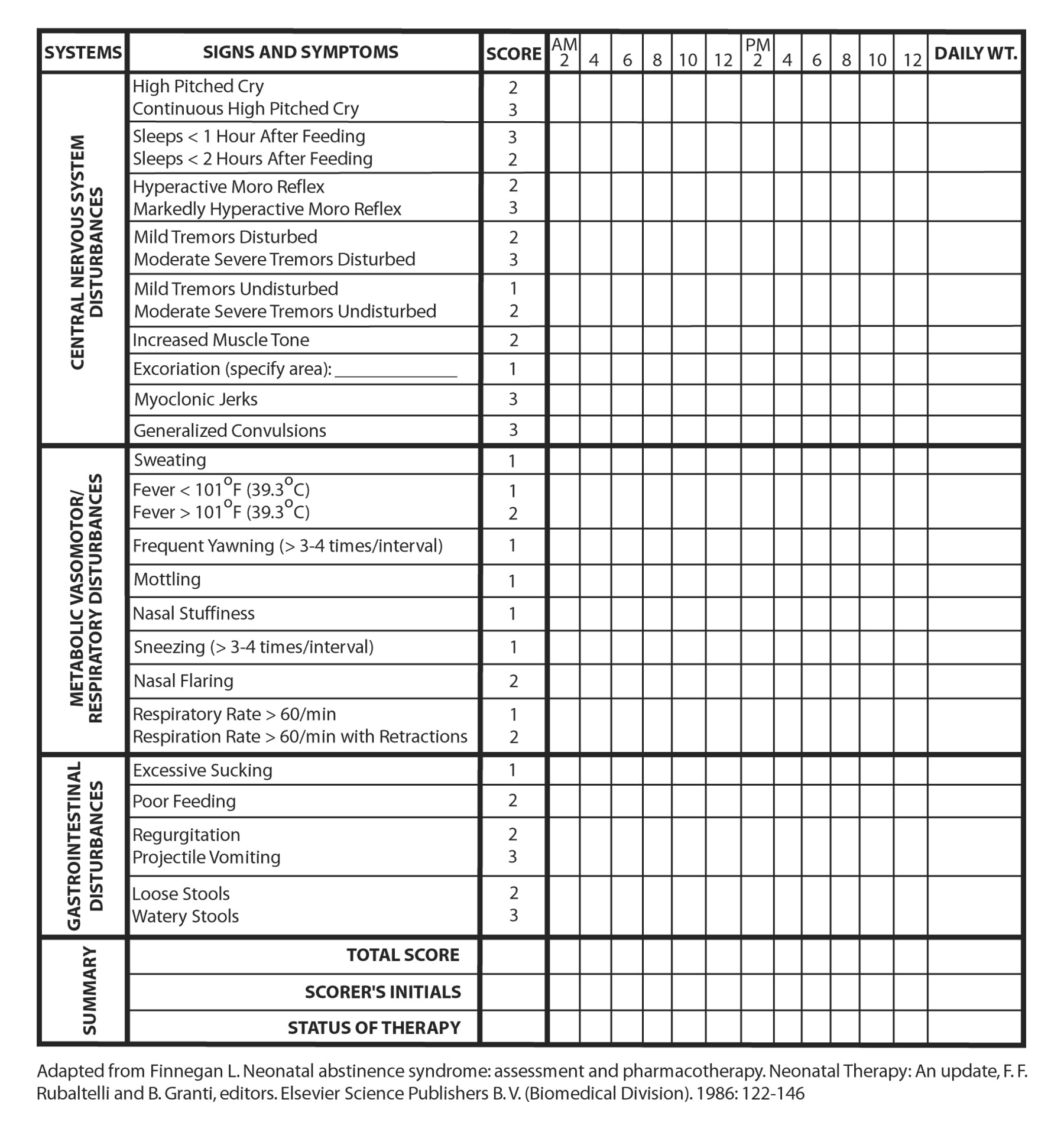
Treatment plans are heavily influenced by scores collected via the Neonatal Abstinence Syndrome Scoring System (click here). Based on a treatment plan like the one in Figure 2, using a standardized scoring system, a score of  8 three time in a row, or 1 score of ≥12 triggers medication administration. At each reassessment of the neonate, medication dosing may increase or decrease based on the withdrawal symptoms shown by the infant. 


Figure 2. NAS Treatment Plan (Kocherlakota, 2014)
Click to enlarge
The ultimate goal of both pharmacological and non-pharmacological treatments is to reduce suffering and improve the infant's growth and entrance into their new life. It is essential to understand that each case is highly variable based on the addicting drug, the length and severity of addiction, the symptoms shown by the infant, and more. Advances are frequently followed by set-backs, and successful weaning could take weeks to months. Despite these giant hurdles, hope for recovery is found in the caring arms of nurses and physicians who are dedicated to providing relief from this challenging start to life (Hudak et al, 2012)


References

Hudak, M., Tan, R., The Committee on Drugs, & The Committee on Fetus and Newborn. (2012) Neonatal drug withdrawal. Pediatrics, 129(2), 540-560. doi: 10.1542/peds.2011-3212.

Kocherlakota, P. (2014). Neonatal Abstinence Syndrome. Pediatrics, 134(2), 547-561. doi: 10.1542/peds.2013-3524

Monday, February 15, 2016

Diagnosing Neonatal Abstinence Syndrome

Neonatal Abstinence Syndrome is identified and diagnosed through the use of several tools including clinical presentation scoring, maternal history, and toxicology screening of tissue samples.

Figure 1. Neonatal Abstinence Scoring System.
Clinical Presentation
After birth during the first few hours/days of life, a newborn is frequently assessed by nurses, pediatricians and other medical professionals. While there are many expected behaviors from newborns such as crying, fussing, acting hungry, etc. there are some behaviors that are abnormal and may mean there is a problem. Signs and symptoms of NAS will be further discussed in another blog post, but a scoring system (Figure 1) is used to standardize documentation of
concerning behaviors that may indicate NAS (Hudak, Tan, The Committee on Drugs, & The Committee on Fetus and Newborn, 2012).

Maternal History
Questions and information about drug use history is part of almost every single hospital admission assessment. Questions about current drug use, past drug use, and drug use by partners, family, and friends are all included in an intake assessment of the mother. However, drug use is frequently under-reported so clinicians also take into account a history of unexplained term fetal demise, severe mood swing, and inconsistency in prenatal care. Additionally, toxicology screenings are done if there is suspicion of drug use based on clinical presentation or history (Hudak, et al, 2012).

Figure 2. Urine Drug Screening 
Toxicology Screenings
There has been a movement to increase the analysis of the baby’s meconium (first bowel movement) to screen for drug substances. This method of screening provides a more longitudinal look at what kinds of substances might have been used even showing substances that were used as early as the second trimester. Baby and mother urine drug screenings are extremely popular but they usually only detect substances used within the last 24-72 hours. Additional samples can be taken from maternal hair, neonatal hair, and even umbilical tissue. These are less popular because of the relatively new technology required to perform and process the screening (Murphy-Oikonen, Montelpare, Southon, Bertoldo, & Persichino, 2010).

There are many factors that contribute to the diagnosis of NAS, and medical professionals are extremely careful to use a range of objective and subjective data to confirm this diagnosis. 


References
Hudak, M., Tan, R., The Committee on Drugs, & The Committee on Fetus and Newborn. (2012) Neonatal drug withdrawal. Pediatrics, 129(2), 540-560. doi: 10.1542/peds.2011-3212

Murphy-Oikonen, J., Montelpare, W., Southon, S., Bertoldo, L., Persichino, N. (2010). Identifying infants at risk for neonatal abstinence syndrome: A retrospective cohort comparison study of 3 screening approaches. Journal of Perinatal & Neonatal Nursing, 24(4), 366-372. doi: 10.1097/JPN.0b013e3181fa13ea

Figure 1 retrieved from http://img.medscape.com/pi/emed/ckb/pediatrics_cardiac/973235-978492-156.jpg 
Figure 2 retrieved from https://www.premierintegrity.com/Images/Protocols_445.jpg